
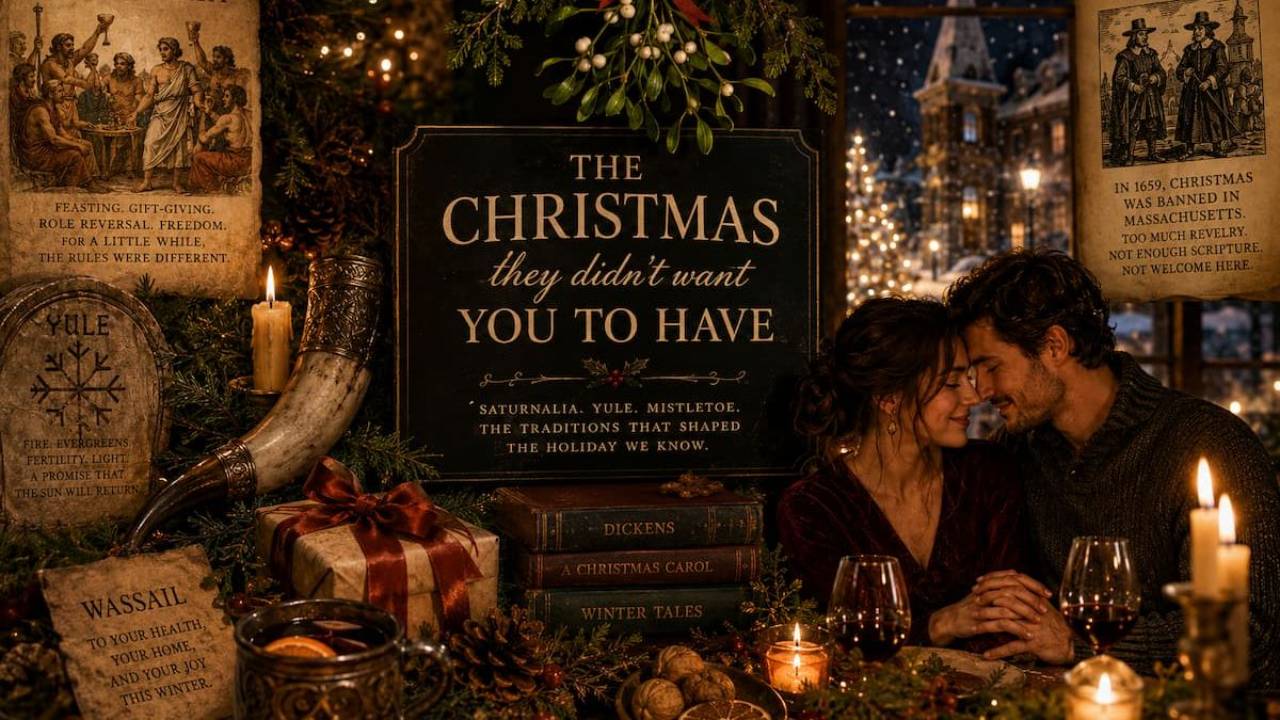
The Christmas They Didn't Want You to Have
Somewhere between the manger scenes, the office parties, and the mall Santas, Christmas became a very tidy holiday.
Which is funny, because midwinter celebrations have rarely been tidy.
The Christmas we celebrate now is layered — Christian tradition, older winter customs, Victorian domesticity, modern commerce, family ritual, and a lingering human instinct to gather close, light fires, eat too much, flirt a little, and make the darkest part of the year feel less dark.
The interesting part isn't proving that Christmas is secretly something else.
It's noticing how much survived.
Saturnalia: When Midwinter Meant Loosening the Rules
Ancient Rome celebrated Saturnalia in December with feasting, gift-giving, gambling, public celebration, and temporary reversals of ordinary social expectations.
It was rowdy by design.
Christmas developed later within that same crowded winter calendar, and historians still argue about exactly how much early Christian celebration borrowed from existing Roman festivals. There isn't a neat line where someone crossed out Saturnalia and wrote Christmas above it.
But the human behavior is recognizable.
Give people a dark winter, food, wine, gifts, time away from work, and permission to loosen the rules a little, and apparently we have been remarkably consistent for a couple thousand years.
The gift-giving survived beautifully.
So did the annual sense that December is a perfectly reasonable time to eat something you would never make on a Tuesday in March.
Yule, Evergreens, and the Human Refusal to Let Winter Win
Northern European midwinter traditions brought their own imagery: fire, feasting, evergreen plants, and celebrations centered around making it through the longest nights of the year.
Evergreens make intuitive sense in that landscape. Everything else looks dead, and there they are — stubbornly green.
Long before anybody was arguing about whether the Christmas tree should be real or artificial, winter greenery already carried the obvious message: life is still here.
Mistletoe accumulated its own mythology over centuries, including associations with fertility, protection, peace, and later romance. The familiar Norse story of Baldr and mistletoe helped give the plant an aura of reconciliation and love, although the modern custom of kissing beneath it developed much later and through a considerably messier trail of folklore.
Which is probably more interesting anyway.
Traditions rarely come with clean paperwork.
The Puritans Really Did Hate Christmas
One thing we can say with considerably more confidence: the Puritans were not fans.
In 1659, the Massachusetts Bay Colony made celebrating Christmas illegal and imposed fines on people who observed it.
Part of the objection was theological. Puritans didn't find a biblical command to celebrate Christ's birth on December 25.
But they also deeply disliked what Christmas had become in practice: drinking, games, public revelry, social disorder, and traditions inherited from older European celebrations.
Basically, they looked at Christmas and saw entirely too much fun happening without sufficient supervision.
The ban didn't last forever, obviously.
But Christmas itself continued evolving. By the nineteenth century, writers including Charles Dickens helped popularize the version many of us now recognize: family gatherings, generosity, children, hearths, food, memory, and sentimental domestic warmth.
That wasn't fake either.
It was simply another layer.
What Actually Survived
Look closely and some of the older winter instincts are still sitting right there beneath the tinsel.
- Wassailing involved drinking, visiting neighbors, singing, and sometimes demanding hospitality with considerably more enthusiasm than modern caroling suggests.
- Mistletoe still gives people socially sanctioned permission to flirt under a plant in December.
- Gift-giving remains one of the season's great pleasures and one of its great sources of mild interpersonal panic.
- Feasting continues almost untouched. We still mark midwinter by putting too much food on a table and inviting everybody over.
- Fire and light remain everywhere — candles, fireplaces, tree lights, outdoor displays — because apparently human beings have never stopped responding to darkness by lighting something.
None of this diminishes the modern holiday.
It makes it richer.
And it fits a pattern you see again and again when you look at older writing about love and intimacy. The things we think of as modern discoveries often have very old roots.
That's part of what makes texts like what the Kama Sutra actually says and the 500-year-old manual for keeping long marriages passionate so interesting. People have been thinking carefully about desire, pleasure, relationships, ritual, and how to live together for a very long time.
We found the same layering when we looked at Halloween's roots in Samhain.
The modern holiday doesn't erase the older one.
It carries traces of it.
So What Do You Do With This?
Honestly?
Whatever you want.
You don't need to rebuild Saturnalia in the living room or start interrogating everyone at Christmas dinner about Germanic winter customs.
It's simply a more interesting way to look at the season.
Christmas has room for the sacred and the ridiculous, children and lovers, family tradition and private ritual, quiet evenings and loud parties. It can be sentimental and sexy, domestic and adventurous, deeply meaningful and completely unserious — sometimes all in the same weekend.
And maybe that's why it has lasted.
Midwinter has always been a good excuse to gather the people you want close, light up the darkness, eat something wonderful, give somebody a gift, and remind yourself that life continues even when the days are short.
The rest of our Christmas collection starts from there: gifts worth giving, date nights worth leaving the house for, a little flirting at the office party, and figuring out where this winter thing is actually going.
Christmas was never only one thing.
That's probably the best part.
A birthday gift from us,
plus picks chosen for your sign.
Join the Romantic Adventures VIP list for a store discount on your birthday, two emails every sun season with picks for your sign, and honest, no-judgment advice all year.
We ask for your birthday to send your gift, and because as an adult retailer we're required to confirm you're 18+. We never sell your info. Unsubscribe anytime.