
Sexual Wellness in America: What the Research Actually Says

Americans have complicated feelings about sex — but the data doesn't. Over the past two decades, researchers at Indiana University, the CDC, and major academic journals have been quietly documenting what's actually happening in American bedrooms. The findings are often surprising, sometimes counterintuitive, and almost always underreported.
At Romantic Adventures, we've spent 25 years in the sexual wellness industry talking with real people about real intimacy. We created this resource because good information matters — for individuals, couples, health professionals, and anyone writing about sexual health in America.
All data on this page is sourced from peer-reviewed research and nationally recognized surveys. Sources are cited at the bottom.
Download the Press Kit (PDF)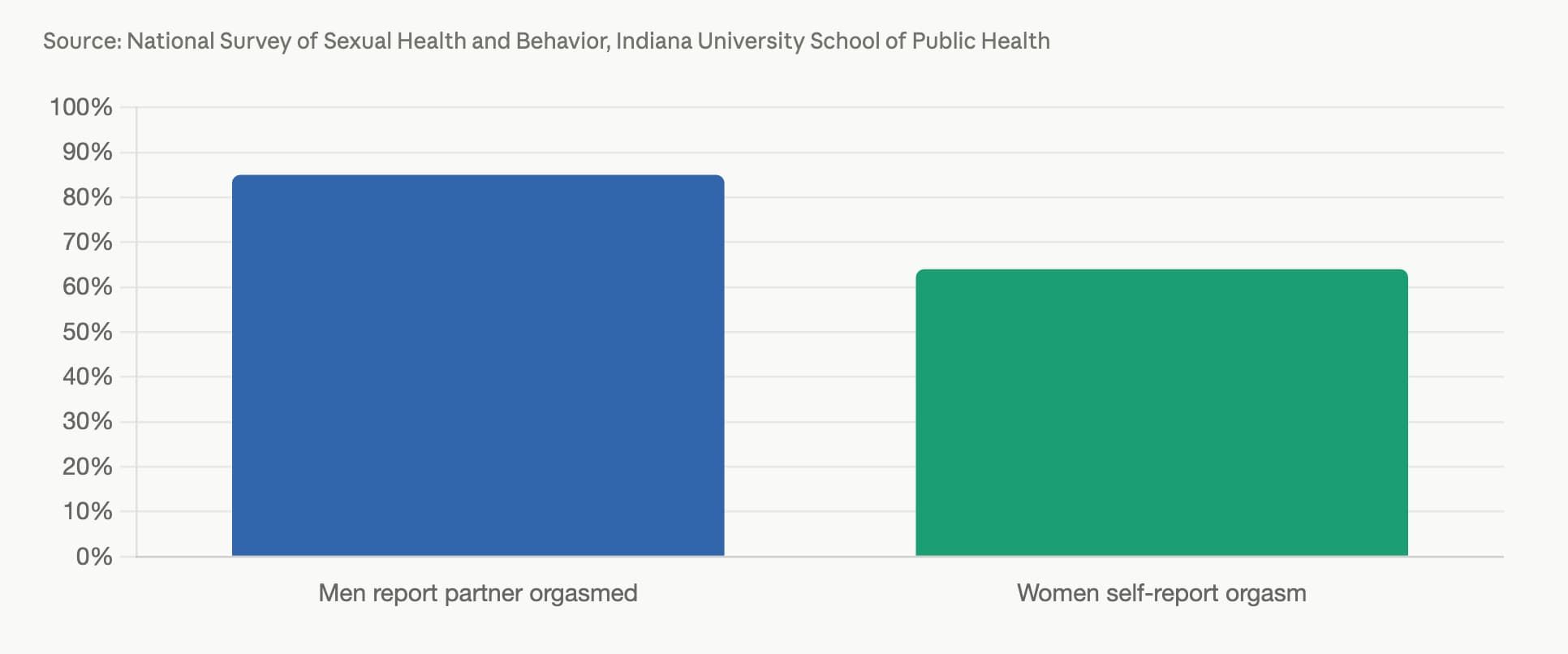
The Orgasm Gap
One of the most consistent findings in sexual behavior research is the gap between male perception and female experience when it comes to orgasm.
According to the National Survey of Sexual Health and Behavior (NSSHB) conducted by Indiana University, 85% of men report that their partner orgasmed at their most recent sexual encounter. Only 64% of women report the same. That 21-point gap is too large to be explained by sampling error — it represents a genuine disconnect between perception and reality.
Research from the same survey found that women are significantly more likely to orgasm when sexual encounters include oral sex or a variety of sexual activities, rather than intercourse alone.
The Sex Recession
Despite cultural narratives about hookup culture and increased sexual permissiveness, Americans are actually having less sex than they were two decades ago — across all age groups, relationship statuses, and demographic categories.
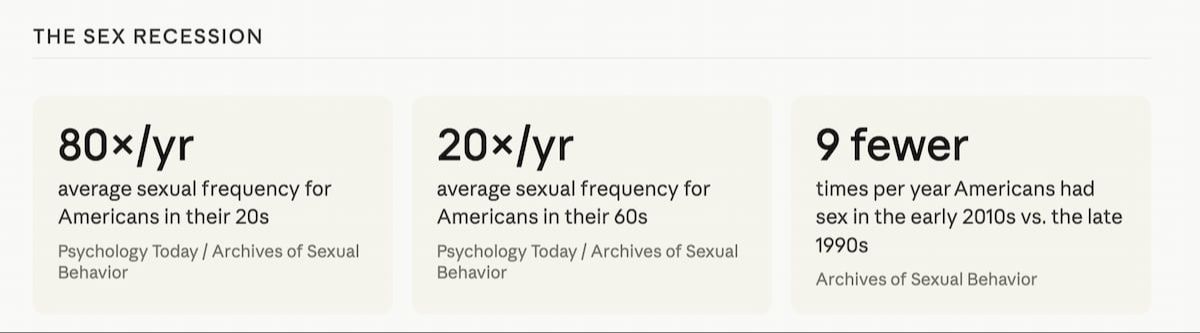
According to research published in the Archives of Sexual Behavior, Americans in their 20s have sex approximately 80 times per year. By their 60s, that number drops to around 20 times annually. But the more significant trend is generational: between the late 1990s and the early 2010s, Americans were having sex an average of nine fewer times per year — a decline that held true regardless of race, religion, education level, or employment status.
The generation with the highest lifetime sexual frequency? The Silent Generation, born in the 1930s. Millennials and Gen Z report the lowest.
Young adults and sexlessness
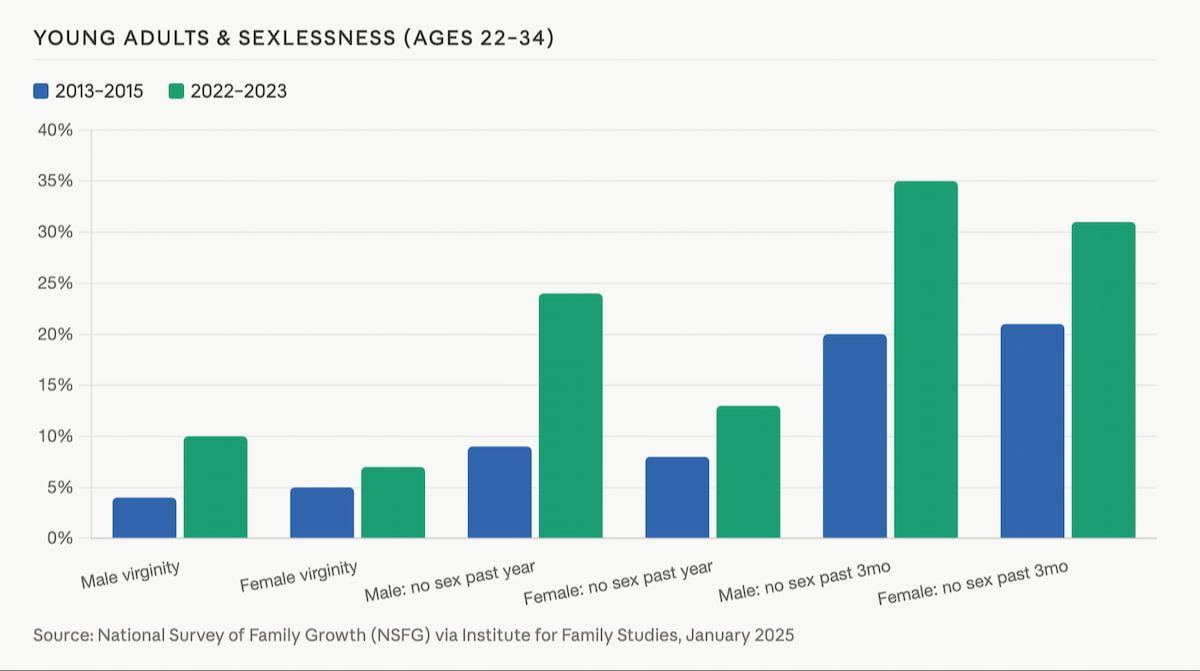
Newly released data from the National Survey of Family Growth (NSFG), analyzed by the Institute for Family Studies in January 2025, documents a sharp rise in sexlessness among adults ages 22 to 34 — the age window when most people historically coupled and started families.
Between 2013–2015 and 2022–2023:
Male virginity among adults 22–34 rose from 4% to 10%. Female virginity rose from 5% to 7%. The share of young adult men reporting no sex in the past year rose from 9% to 24%. For young adult women, that number rose from 8% to 13%. Men reporting no sex in the past three months rose from 20% to 35%. Women reporting the same rose from 21% to 31%.
Researchers note that the primary driver appears to be delayed and declining marriage rates — married people consistently report higher sexual frequency than unmarried people, and marriage is occurring later or not at all for a growing share of young adults.
Solo Intimacy Is Increasing, Especially Among Younger Adults
Industry survey data adds a further data point to the sexlessness trend documented above. Vibratex's 2026 Sexual Wellness Trends Report, based on a survey of 1,000 women and nonbinary adults with vulvas conducted in partnership with sex researcher Dr. Candice Hargons (Emory University), found that while younger respondents reported having less partnered sex than older generations, they reported more frequent solo sex — suggesting a generational shift in how sexual desire is being met, not simply a decline in desire itself (Vibratex, 2026).
Note: unlike the peer-reviewed and federally-collected data cited elsewhere on this page, this finding comes from an industry-commissioned consumer survey rather than an academic or government source. We include it because it's directionally consistent with the academically-documented sexlessness trend above, but it should be weighted accordingly — as a data point, not a definitive finding.
Taken together with the sexlessness data already on this page, a pattern emerges: young adults appear to be having less partnered sex, but that doesn't necessarily mean less intimacy, less desire, or less engagement with their own sexuality. For a growing share of people, solo intimacy is functioning as an intentional practice rather than a fallback — which tracks with what the nervous-system research above would predict: intimacy with oneself still depends on the same underlying sense of safety and presence as intimacy with a partner.
The sex recession data raises an obvious question: what do people do with unmet desire? One answer showing up in the cultural data is fiction. The contemporary romantasy boom — driven heavily by women in the 25–50 demographic, the same group the sexlessness numbers describe most sharply — isn't coincidental timing. Women who are having less partnered sex are not, by all appearances, wanting less. They are reading Fourth Wing at 2 a.m. and feeling something real.That's worth taking seriously rather than dismissing. Fictional intimacy at its best functions as emotional literacy — a precise, embodied vocabulary for what attunement, desire, and being truly seen actually feel like. It's the doorway in, not the endpoint. We explore this more fully in our Book Boyfriend content hub, which examines the psychology behind the phenomenon and why the women driving this reading wave are neither naive nor starved for attention — they're mapping their own terrain.
Vibratex, Inc. (2026). 2026 Sexual Wellness Trends Report [Magic Wand Wellness Study]. MagicWandOriginal.com/trends.
Sexual activity across the lifespan
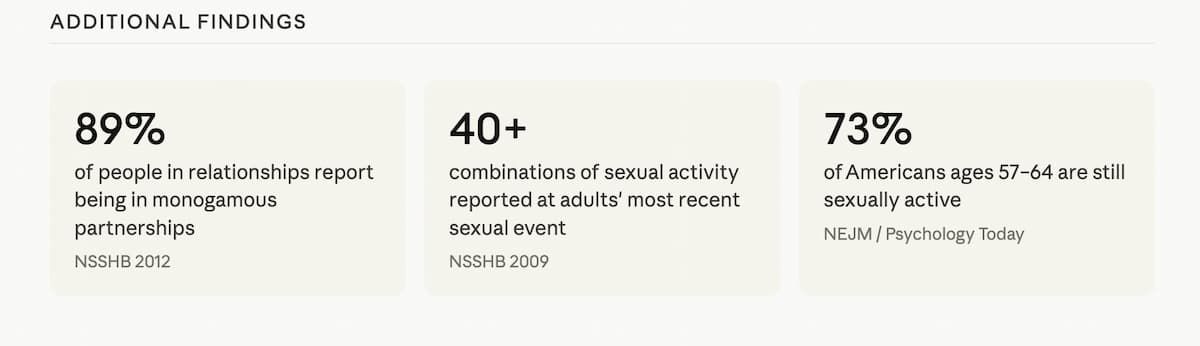
Sexual activity doesn't end at midlife. Research published in the New England Journal of Medicine found that 73% of Americans ages 57 to 64 remain sexually active. That number drops to 53% among those 65 to 74, and to 26% among adults 75 to 85.
Women are less likely than men to report sexual activity at every age — a finding researchers attribute to a combination of health factors, partner availability, and cultural messaging about sexuality and aging.
"Sexspan: The Emerging Longevity Metric" A 2025 peer-reviewed paper in Trends in Urology & Men's Health (Saffati & Khera) identifies sexual vitality as a measurable component of healthy aging — and finds it is systematically underaddressed in wellness culture.
What the data means
The picture that emerges from this research is not one of a sexually liberated culture. It is one of a culture where many people are having less intimacy than they want, where significant gaps exist between partners' experiences, and where reliable information about sexual wellness remains difficult to find and discuss openly.
Sexual wellness products, education, and honest conversation are not luxuries. For many people, they are the practical bridge between where they are and where they want to be.
This data doesn't exist in a vacuum. Humans have been navigating intimacy, desire, and connection for thousands of years — and writing it down. If you want to understand where this wisdom tradition comes from and why it still matters, start here: The Ancient Art of Loving: A History of Sexual Wisdom
Sources
National Survey of Sexual Health and Behavior (NSSHB), Indiana University School of Public Health — nationalsexstudy.indiana.edu
Twenge, J.M., Sherman, R.A., & Wells, B.E. (2017). Declines in Sexual Frequency among American Adults, 1989–2014. Archives of Sexual Behavior.
Ueda, P. et al. (2020). Trends in Frequency of Sexual Activity and Number of Sexual Partners Among Adults Aged 18 to 44 Years in the US, 2000–2018. JAMA Network Open.
Stone, L. (2025, January 21). Sexless America: Young Adults Are Having Less Sex. Institute for Family Studies.
Lindau, S.T. et al. (2007). A Study of Sexuality and Health among Older Adults in the United States. New England Journal of Medicine.
Romantic Adventures has served the Central Mississippi region since 2001. We carry sexual wellness products, intimate accessories, and educational resources for individuals and couples at every stage of life. Browse our online workshops or visit us in Pearl, Mississippi.
The Nervous System and Arousal
A newer area of research is reshaping how clinicians think about arousal and desire: polyvagal theory, developed by Stephen Porges at the Kinsey Institute, Indiana University. The theory holds that feelings of safety are not just psychological — they're a measurable, physiological state governed by the autonomic nervous system, and that state has to be in place before arousal and pleasure can fully occur (Porges, 2022).
This isn't a fringe idea. A 2020 study published in Psychological Trauma: Theory, Research, Practice, and Policy found that self-reported autonomic reactivity — essentially, how regulated or dysregulated a person's nervous system is — directly mediates sexual function, particularly in adults with a history of childhood maltreatment (Kolacz, Hu, Gesselman, Garcia, Lewis, & Porges, 2020). In plain terms: the body's sense of safety isn't background noise to intimacy. It's one of the mechanisms driving it.
Clinically, this reframes a common but rarely discussed problem. Difficulty with arousal, presence, or orgasm is often treated as a technique or attraction problem. The nervous-system research suggests that for many people, it's a regulation problem — the body hasn't shifted out of a defensive or hypervigilant state, regardless of how attracted someone is to their partner.
What this means practically: interventions that build a felt sense of safety — slower pacing, breathwork, honest communication about pace and consent, reducing performance pressure — aren't "soft" additions to sexual wellness. They're addressing a documented physiological prerequisite.
Porges, S.W. (2022). Polyvagal Theory: A Science of Safety. Frontiers in Integrative Neuroscience, 16:871227.
Kolacz, J., Hu, Y., Gesselman, A.N., Garcia, J.R., Lewis, G.F., & Porges, S.W. (2020). Sexual function in adults with a history of childhood maltreatment: Mediating effects of self-reported autonomic reactivity. Psychological Trauma: Theory, Research, Practice, and Policy, 12(3), 281.
Sexual violence in the U.S. — the current numbers
Source: CDC, National Intimate Partner and Sexual Violence Survey (NISVS), 2023/2024 — the first national update since 2016/2017. This is the most recent comprehensive federal data on sexual violence in the United States. National Sexual Violence Resource Center
- Nearly half of U.S. women — 45.1% — have experienced contact sexual violence in their lifetime. (This is the headline. Lead with it.) VAWnet
- 1 in 5 women (21%) have experienced a completed or attempted rape. VAWnet
- 39% have experienced unwanted sexual contact; 20.3% have experienced sexual coercion. VAWnet
- About 1 in 3 women have faced verbal sexual harassment — in the workplace (30.4%) or in a public place (29.5%). VAWnet
- More than 1 in 4 women (28.2%) have experienced technology-facilitated sexual violence. VAWnet
- Often begins in childhood — in CDC data, 42% of victims experienced their first completed rape before age 18. colorado
- And it isn't improving: the rates remain high across the country. VALOR US